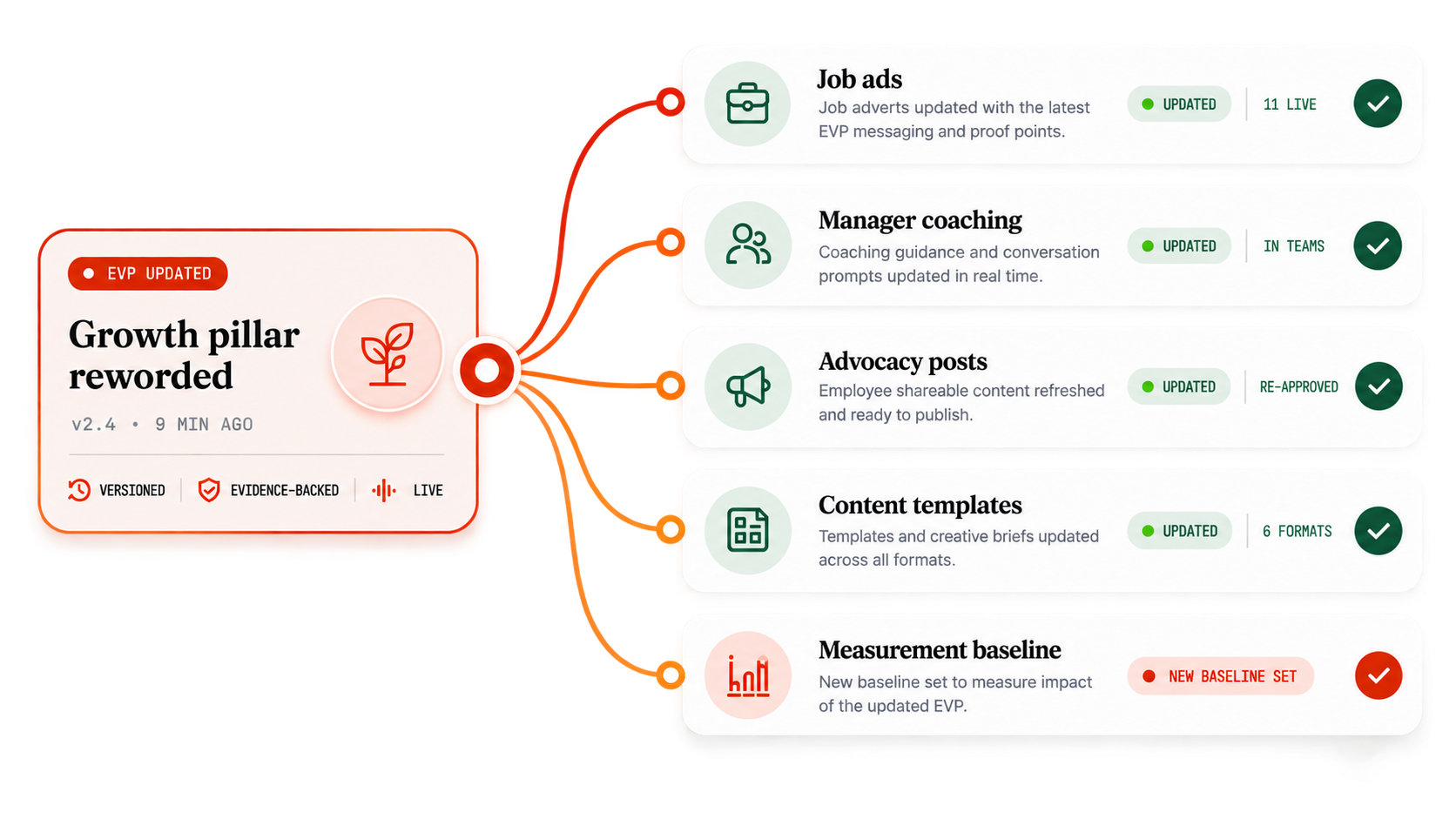
Diagnostics, evidence, measurement, content, coaching and governance in one place, all reading from a single living EVP. Not a stack of point tools that each hold their own version of the truth.
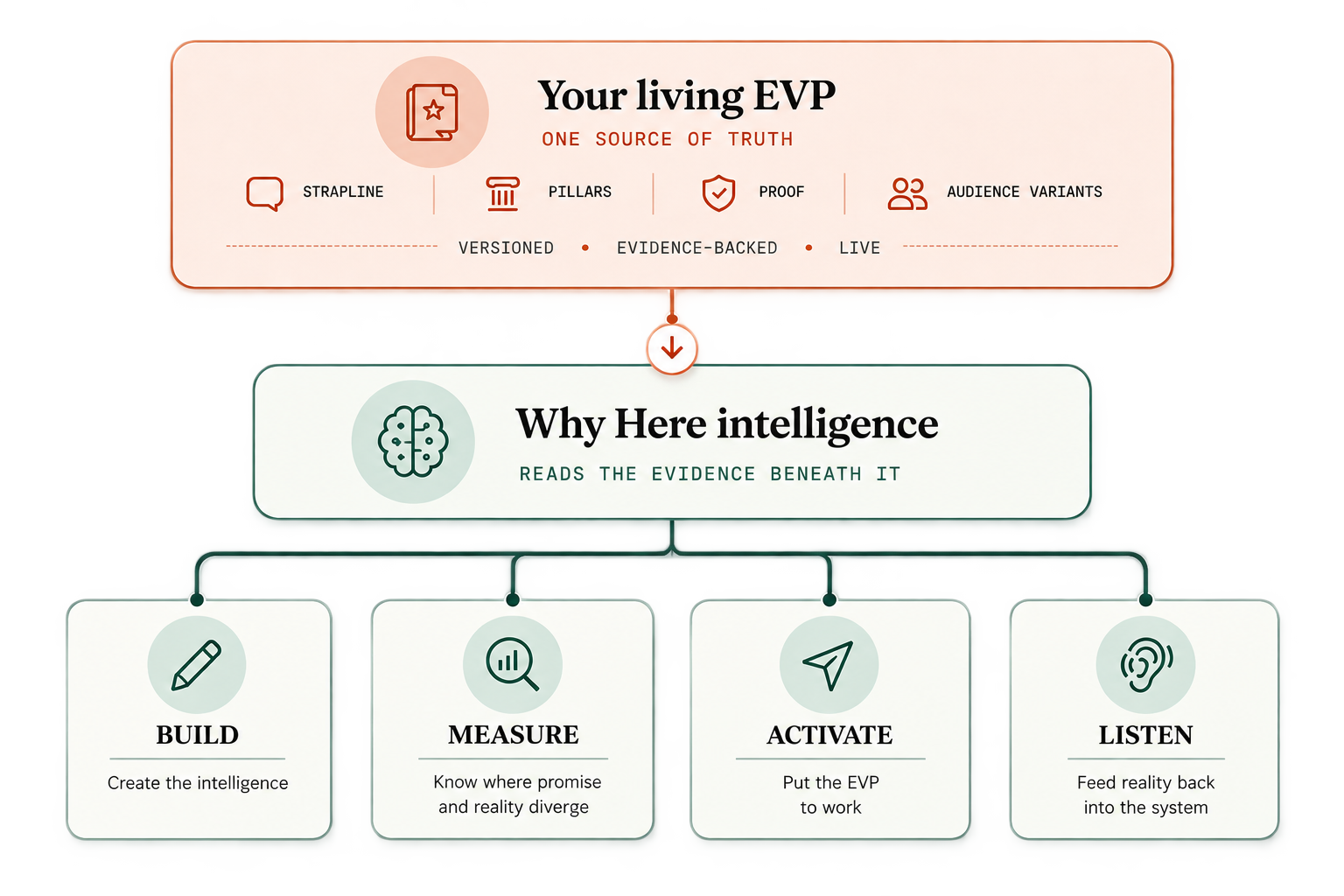
Point tools each hold a fragment and none of them hold the whole, which is why nothing reconciles. Here every capability inherits from one EVP, so a change at the centre reaches everything downstream.
The one line the whole promise turns on.
What the organization actually stands for, in four claims.
The evidence beneath every claim, traceable to source.
The same promise, framed for each group that hears it.
This is the object every other part of Why Here reads from.
Grouped the way the system runs rather than alphabetically, because the order is the argument: you cannot activate what you have not grounded, and you cannot improve what you do not measure.
An eight-dimension read of where your employer brand stands, scored and comparable over time.
Surveys, voice interviews, recordings and existing documents, gathered in research mode rather than brand mode.
Raw voice becomes structured themes, each showing the evidence beneath it.
"Real decisions early, without waiting for sign-off."
Strapline, narrative and pillars assembled from the evidence, with audience variants built in.
The draft goes back to employees before you commit, so you know where it rings hollow.
Every segment scored on importance against lived experience, so you see which pillar leads for whom.
One number for promise against reality, and a trend line proving whether it is closing.
Review sites and public signals mapped to your pillars, so outside perception sits beside inside reality.
A workspace per purpose, each inheriting the EVP without a briefing document.
Enablement, not a content machine. Kick-off calls, practice interviews, manager training and talent intelligence. Recruiters become advisory, hiring managers self-sufficient.
Job ads, campaign copy and interview kits, scored against the EVP before anyone publishes.
Posts written for your people, caption already there, so advocates share in one tap.
"The arm I commissioned last spring is now in a hospital in Munich."
The one-to-one, the onboarding week, the difficult change conversation, advised inside Microsoft Teams.
"Growth is your widest gap in engineering, so lead with the stretch project."
Pulses, reviews and signals come back in, map to your pillars, and move the score.
Configurable approval chains with a full audit trail on every published output.
Role-based access across markets and sub-brands, with a brand score on every output.
When your EVP evolves, Why Here carries that intelligence through every connected experience and output, without re-briefing every team or rebuilding every asset.
Wherever someone meets Why Here, the same evidence and the same EVP context comes with them. A recruiter opening a workspace, a manager asked for advice in Teams, an advocate reaching for a post: each is answered from one body of intelligence rather than a separate tool with its own memory.
"You have a growth conversation with Sarah on Thursday. Growth is your widest gap in engineering, so lead with the stretch project, not the ladder."
The three questions a security review asks first, answered structurally rather than in policy language.
Use the AI provider your organization has already approved: Anthropic, OpenAI, Mistral, or your own endpoint and key.
Your evidence and organizational context stay isolated and controlled, in the region you choose.
Human approval, permissions and auditability are built into the workflow rather than bolted beside it.
Architecture, entry points and the full security posture: Trust and security
Many front doors, one spine behind them. Nobody has to learn a new tool to take part.
People do not always need to log into Why Here. The intelligence reaches them in the tools and moments where they already work, reading from the same isolated data and the same living EVP.
Book a demo and we will walk your own employer brand through it end to end: how the EVP is built, where the gaps are, and what closing them would take.